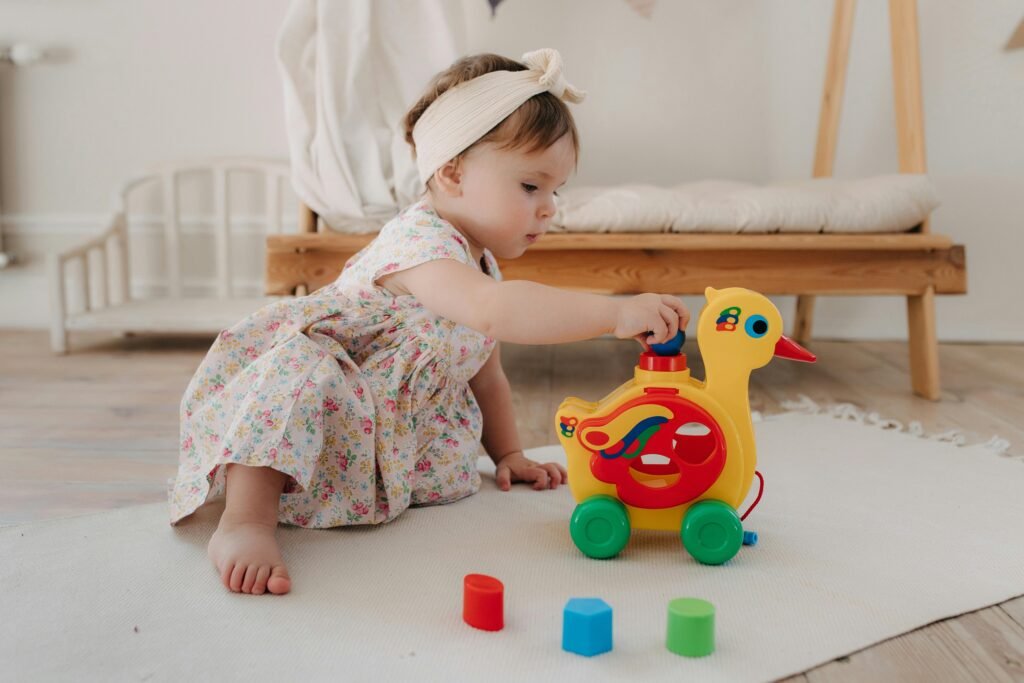
For most people, when you think about kids, you think about toys. I still remember the Tickle Me Elmo that I was obsessed with as a child. And as I got older, my toy interests changed, and I soon became obsessed with Barbies. But for babies, the toy transition from birth into toddlerhood isn’t just about the entertainment — it is a journey that shows how your baby sees, moves, thinks and interacts with the world.
In the early months, simple sensory toys support visual focus and gentle exploration. By the end of the first year, babies are grasping, shaking, and experimenting with cause and effect. And as toddlers approach age two, play transforms again into building, problem-solving, and imaginative discovery. Understanding this natural toy transition helps parents choose items that not only delight their child, but also nurture each exciting developmental leap along the way.
While every baby is different, I’m here to share my daughter’s toy journey — which she is still going on as she approaches 2 years old this summer. There are definitely toys that we’ve bought that have barely been used, as they were of no interest to our daughter. But there have been toys that she has absolutely LOVED and is obsessed with. And I’m here to share some of those recommendations!
0 - 6 Months
During the newborn phase, babies explore toys primarily through sight, sound, touch and movement. As this age, vision is still developing, so they’re very drawn to high-contrast patterns, bold colors, and faces. Babies learn through their senses—looking, listening, touching, and eventually, bringing toys to their mouths.
Sensory toys are the name of the game at this age. Simple toys like soft rattles, textured balls, crinkle cloth books, and play gyms encourage reaching, kicking, grasping, and tracking movement with their eyes. Even the act of batting at a dangling toy helps build early hand-eye coordination and muscle strength. Exploration at this age isn’t complex or goal-oriented — it’s about sensory discovery. Every shake that makes a sound or texture that feels new teaches babies an important lesson about cause and effect, laying the foundation for future motor skills and cognitive growth.
Toy Recs
Note: As an Amazon Associate I earn from qualifying purchases.
The number one toy on a baby registry is a play mat/ gym. And there is a wide offering of these online—from the simple, yet very effective Fischer-Price Baby Playmat & Piano Gym to the expensive, yet aesthetically pleasing Lovevery Play Gym—all help baby learn and grow.
My husband and I went with the Fischer-Price playmat and our daughter loved it! The rainbow arch with the 4 dangling toys were a huge hit for her. I can still remember her spending her days on her back swatting at the toys. When she learned to grasp she would yank the whole arch down and we had to remove the toys so that she could explore the dangling toys with her mouth. She also loved the piano attachment, as she would lay on her back and kick kick kick the piano.
As she got older, she was still able to use the play gym—she crushed tummy time on the play mat, and eventually she would sit up and hit the piano (which is tilt-able) with her hands. If you go with the Fischer-Price playmat, know that the “purple monkey” song will be in your head for a while, but it’s a banger of a song!
Some of the other toys our daughter utilized during this newborn phase included the High Contrast Flashcards/ Black & White High Contrast Book, as well as the Flip Fish Baby Toy. The flash cards/ book were perfect for a high contrast activity during tummy time, as well as helping teach our daughter different objects. The flip fish was a great sensory toy for our daughter’s ears and hands as it makes different sounds (crinkles, squeaks, etc.) and has a variety of textures.
The Skip Hop Explore & More Activity Center was also a key play thing for our daughter, starting around 4 months or so when she was able to sit up. This activity center grows with baby and can transform from a sit, swivel, bounce & play activity center into a full on table—which our daughter uses today with chairs. There are multiple development activities on the activity center including a musical light-up piano, a peek-a-boo owl, and more—these clip on toys attach directly to the table for baby to play with while sitting inside. Highly recommend this activity center, as it is an easy put-baby-down spot where you can go on to do other things (nearby of course), such as cleaning or cooking.
Lovevery Subscription
Lovevery has become a popular brand for child toy subscriptions. Lovevery approaches toys with developmental intuition, designing each toy to support the specific skills babies are building at every stage. Rather than simply entertaining, Lovevery play kits are curated around expert-backed milestones, helping caregivers choose toys that match a child’s growing sensory, motor, and cognitive abilities.
Lovevery offers play kits for all ages, starting with the newborn phase, with a new play kit arriving every 2-3 months. For many parents, Lovevery takes the guesswork out of selecting age-appropriate toys during the rapid transitions, ensuring playtime is both joyful and enriching.
We started our daughter on a Lovevery subscription starting with the Charmer Play Kit (designed for ages 3-4+ months)…mainly because I wasn’t fully sold on the idea of a toy subscription to purchase the initial play kit.
- I was hesitant to spend the money on Lovevery, as I know it is more expensive to purchase the subscription vs buying individual toys (I even debated buying the individual toys myself instead of doing the subscription). I also didn’t want to waste money on the play kit if we already owned similar toy(s).
- I knew the Lovevery subscription could be a commitment as well, and I try to avoid subscriptions. Thankfully the Lovevery subscription is skippable by play kit, and I can cancel any time.
However, I came around on the idea as the Lovevery subscription has saved me so much time (and decision making) in not having to look into toys that are developmentally appropriate for my daughter. The Lovevery play kits offer a wide variety of toys, all made with high-quality, safe, materials that are designed for kids. The play kits include a guidebook with details about each toy, guidance about baby’s development, and fun ways to play/ DIY activities by age.
Lovevery Toys
Our daughter really enjoyed the Soft Book in the Charmer Play Kit—it offered multiple textures for her to explore. The Framed Mirror was another hit for our daughter from this same play kit as she loved seeing her reflection during tummy time.
From the Senser Play Kit (designed for 5-6+ months), our daughter LOVED the Magic Tissue Box—she thoroughly enjoys pulling out the tissues. It was always a bummer when she got to the end of the tissue box, and then my husband & I would have to re-attach the tissues and put back into the tissue box. The Spinning Rainbow was also a hit for our daughter, she very much enjoyed spinning the toy—and it helped her practice her fine motor skills and hand-eye coordination.
6 - 12 Months
At 6 months of age, babies become more active — sitting, crawling, pulling up to stand — and intentional in how they explore toys — grasping, banging, shaking toys. Sensory discovery transitions to hands-on experimentation with toys. Babies love toys that can bang, shake, drop, stack, and pass from one hand to another. During this stage, cause-and-effect truly clicks for babies (press a button and it lights up, drop a block and it falls, shake a rattle and it makes noise—experimentation meets sensory).
Toys like stacking rings, soft blocks, activity tables, and simple musical toys support fine motor skills while also encouraging problem-solving and coordination. Babies at this age are curious investigators, repeating actions over and over to understand how things work and building the foundation for more complex learning in the year ahead.
Toy Recs
I think it was around this phase where we probably bought more toys than we needed to for our daughter. There was always a new and exciting toy to want to introduce to her, and she was much more interested in toys around this time as she could really interact with the toys.
One of her favorite toys around 6-12 months, and even to this day, is the Mushie Stacking Cups. At first, we would stack the cups for her and she would have a blast knocking them over—she even still enjoys this. However, she would also enjoy trying to stack the cups herself, either on top of each other or into each other.
She also really enjoyed the Fisher-Price Stacking Rings—they were great to chew on as well, and the red (top) ring rattled! To this day she still plays with the stacking rings, including putting all of the rings (that will fit) on her legs and/or arms (to wear as anklets or bracelets).
Another toy that we introduced to our daughter during this time was the VTech Activity Cube. This toy has 5 sides of play with light-up buttons and interactive features to encourage discovery and exploration while developing fine motor skills for your baby’s growing mind. Since the toy is a cube, it also helped our daughter sit up and pull herself up while holding on to.
Lovevery Toys
The Ball Drop Box was a massive hit from the Inspector Play Kit (designed for 7-8+ months). It took a while for our daughter to figure out how the ball drop box worked, but once it clicked, it really clicked and she started dropping the wood balls into the hole and watching the cause-and-effect of the ball rolling back down.
The ‘Things I See’ Texture Cards were a big step up from the black and white contract cards that our daughter was playing with as a newborn. These cards have one side with an object that is textured (such as a shoe with actual shoe laces on it, or a dog with soft fur on it). Our daughter had a blast playing with these cards, and was able to learn some words with these cards at a young age.
I will admit, the Explorer Play Kit (designed for 9-10+ months) was not my favorite, and our daughter did not take to many of these toys. However, the Thinker Play Kit (designed for 11-12+ months) was a fan favorite for our girl. This play kit came with a lot of cause and effect type toys, such as the Sliding Top Box (which helped build problem solving skills, as our daughter had to learn how to slide the top of the box to remove the ball inside), and the Wooden Peg Drop (which also helped build problem solving skills, as our daughter had to learn how to pull the lever to allow the pegs to fall). This play kit also included a Sensory Switchboard, which helped teach our daughter how to push, flip and twist.
1 - 2 Years Old
Between ages one and two, play becomes more purposeful, physical, and imaginative. Toddlers are now walking, climbing, carrying, stacking, and beginning to pretend, which means they explore toys with much more intention. This stage is full of trial and error — stacking blocks just to knock them down, opening and closing containers repeatedly, or figuring out how pieces fit together.
Toys that support problem-solving, fine motor control, language development, and early pretend play are especially valuable. Exploration at this age is active and curious, as toddlers test independence, repeat actions to master skills, and use play to better understand how their world works.
Toy Recs
Our daughter started taking steps with the walker around 12 months old, and really took off walking at 13 months. The VTech Stroll and Discover Activity Walker was a fan favorite for our daughter—she loved pushing that thing around the house. This walker definitely helped her start walking and gave her the courage to walk without help. The activity center on the front of the walker is also a fun toy that our daughter enjoyed playing with.
Puzzles also became a a great toy for our daughter as it tested her problem solving skills and her fine motor skills to get the pieces into the spots. She still enjoys playing with puzzles—they’ve evolved from “simple” shape puzzles to miscellaneous shape puzzles (such as her name puzzle).
One brand of toy that our daughter fell in love with is the Fischer-Price Little People interactive toys—such as the Little People Friends Play House and the Little People Interactive Car Wash. These toys have 3 smart stage levels with songs, sounds and phrases about the alphabet, counting, etc., along with light-up switches and attachments. These two toys have sparked imaginative play with our daughter, who loves the lights and sounds, as well as the little people that come with the toys.
Our daughter’s 18 month birthday fell right around Christmas so we put a handful of toys on her Christmas list. For Christmas, my husband and I purchased a Toy Kitchen for our daughter—we thought this was a good age to introduce some imaginative play with the kitchen. Our daughter is still learning full-on imaginative play, but she loves playing with the fake food (her Mee-maw and Grandpapapa bought her a 115+ piece set of food items).
Her Mee-maw and Grandpapapa also bought her a Pickler Triangle Set which has been a huge hit for our daughter—she LOVES climbing. Before Christmas she was starting to climb on our coffee table, which we had to constantly take her off of. The pickler triangle set has been played with almost every day since Christmas.
Another gift that our daughter received for Christmas, from her Gigi and Papa, was a Little Tikes Cozy Coupe. My parents even customized the car for her with a name license plate! She thoroughly enjoys being pushed in this car throughout the house (we’ve kept it as an indoor only car for now). She has learned how to push herself in the car (backwards mainly) and always has to take some of her fake food from her toy kitchen with her (usually her noodles).
As I am wrapping up writing this blog post, we just purchased a few new toys for our daughter, including a Baby Doll. Our daughter is still learning how to express her emotions, and sometimes she will swat her arms, or even bite herself, when she’s frustrated. We thought a baby doll would help teach her how to be kind and gentle, as she can practice on the baby doll—as my husband and I help narrate and encourage the kind words and actions.
Lovevery Toys
After 1 year old, the play kits arrive every 3 months. The first play kit after 1 year old — The Babbler Play Kit (designed for 13, 14, 15+ months) — has probably been the best play kit thus far; our daughter has played with/ plays with every single toy in this play kit.
- The Wooden Coin Bank Set, with alternate lids (posting lid & trees, carrot lid & trees), has been an excellent toy for our daughter to practice her fine motor skills. The alternating lids provide different shapes for our daughter to learn to place into the box.
- The Slide & Seek Ball Run has been a fun object permanence toy for our daughter, as she places the ball on the top slot, pushes it down and lets it roll down the slide into the bottom box. The box at the bottom has 4 different doors which challenges our daughter to figure out how to open them in order to retrieve the balls.
- The Wooden Stack & Slot is a twist on the original ring stack (which had fatter rings) and allows our daughter to learn how to stack, unstack, push, and watch the rings roll away while learning about spatial relationships and depth perception. Unfortunately, our dog chewed the yellow ring, so now she is one ring short on her 10 ring rainbow.
The Adventurer Play Kit (designed for 16, 17, 18+ months) was another very popular play kit for our daughter; she has really enjoyed all of the toys in this play kit.
- The Copy Me Cups have been so much fun our daughter—she knows all of the cups back to front (touch your nose, pat your tummy, etc.) and has taught her easy one-step directions along with teaching her body parts.
- The Wooden Stacking Pegboard has been another great stacking toy for our daughter to learn and play with, as it combines fitting small objects into small spaces while building colorful towers of wooden pegs.
To be honest, I was planning to cancel the next play kit — the Realist Play Kit (designed for 19, 20, 21+ months) — as it included a wheel around bus (which our daughter already has one—the Fisher Price Little People Bus), and it included another puzzle. I didn’t think the toys were necessary for her, so I was planning to skip this play kit (easy to do on the app), but forgot to do in time, and as such we received.
- The Lockbox has been a great problem solving toy for our daughter as it includes 4 different locked sides on the box, which has helped encourage our daughter’s mechanical thinking. We’ve been putting balls and Little People in the box and locking all sides to encourage her to get inside the box.
- The Quilted Critter Pockets has been a popular toy for our daughter right now as well. The toy has promoted matching and dexterity to tuck the critters into the pockets. We’ve enjoyed asking her “where’s the elephant?” and watching her find and pull the critter out of the pocket. Once all of the critters are out of the pockets, she likes putting them all back into the pockets—she still needs a little bit of help getting the critters all the way into the pockets, but is getting there.
I’m looking forward to the next play kit arriving in a couple months!
As your baby grows from a tiny newborn into a curious, on-the-move toddler, their toys should grow with them. The transition from soft, high-contrast toys to interactive cause-and-effect toys and eventually to imaginative, skill-building toys isn’t just about keeping things interesting — it’s about supporting your child at every stage of their development.
Thoughtfully designed programs like those from Lovevery make this transition easier by offering age-appropriate toys that align with developmental milestones. Lovevery has helped me take the guess work out of which toys are developmentally appropriate for my daughter. The subscription’s toy rotation and upgrade has encouraged sensory exploration, motor skills, language development, and early problem-solving for my daughter.
Remember, the best toy at any age isn’t the flashiest one — it’s the one that meets your child right where they are and inspires them to explore just a little further. It’s been so much fun watching our daughter’s transition in learning and growing with different toys over the past 20 months, and I look forward to the many more future toys to come!