Baby sleep is one of the greatest mysteries of parenthood. Some babies are colicky and up all the time, while other babies may enjoy their zzz’s. As with everything, each baby is different, and it’s part of the adventure of parenthood to figure out what works for you and your baby.
It starts with the newborn phase where baby is waking up every few hours to eat, and everyone tells you to “sleep when baby sleeps.” As baby gets older their sleep windows continue to extend, which delights parents who are craving more sleep. Eventually baby learns to sleep through the night and it’s a shock to the system for most parents who are used to fragmented sleep. However, there’s always the dreaded sleep regressions which can occur due to a variety of reasons (growth spurt, teething, etc.).
I’m here to share my daughter’s sleep journey, with the hopes that it can help other mommas out there who are trying to find a method that works for their family.
Newborn Phase
Note: As an Amazon Associate I earn from qualifying purchases.
SNOO Bassinet
To start, my daughter slept in a SNOO bassinet from birth to ~5 months old. For those of you who are not familiar with the SNOO, it is a “smart” bassinet designed to combine multiple soothing techniques (swaddling, motion and sound) to help baby sleep longer. The SNOO has atomic rocking and white noise to help soothe baby when they start to cry – with multiple soothing levels (also adjustable via the app).
Happiest Baby claims that the SNOO bassinet adds 1-2 hours of added sleep per night. I was initially skeptical of this claim and the ability of the SNOO to help our daughter sleep, but in the end, my husband & I loved this bassinet. It worked very well for our daughter.
We probably would not have purchased (or even leased) the bassinet on our own given the price, but my company covered a 6 month lease of the SNOO bassinet so we took advantage of this perk. We also received a hand-me-down bassinet from my sister-in-law to have as a backup, but we did not need in the end.
I raise this point as I believe there is a difference in baby sleep when using a traditional bassinet vs the SNOO bassinet. Again, every baby is different, and not all babies will like the SNOO. But I think there can be a difference in the sleep that a baby gets in a SNOO vs other bassinet.
Feedings
During the first few weeks of the newborn phase babies are typically eating every 2-3 hours given their tiny stomachs. Most of their awake time is spent eating (or peeing and pooping!). As such, babies are only getting 2-3 hours of sleep at a time.
Our daughter was one of those babies who needed to be woken up to feed — there were only a handful of times in the newborn phase where she would wake us up telling us that she was hungry. Most of the time we had to set alarms to wake her up to feed her.
After our daughter hit her birth weight, the doctor told us that we no longer had to wake her up to feed her, and we could let her sleep (and she could tell us when she was hungry). At first this gave us an extra hour or so of sleep, as baby girl was sleeping in 3-4 hour stretches instead of 2-3 hour stretches.
2 Months - 5 Months
Naps
At 2 – 5 months our daughter wasn’t on a set schedule for naps — she would sleep periodically throughout the day, from 30 min naps to 2 hour naps. I was still doing my morning walks daily, and most of the time my daughter would sleep in the stroller bassinet. Eventually, around 3 months old she started to hate the stroller and would cry, so I had to limit my morning walks with her.
This “routine” helped me keep an open schedule where I wouldn’t be tied down to specific times for baby girl to nap, as she would just nap when she wanted during the day. Most days she would nap on the couch with us in the evening as we watched tv, which we enjoyed as a family.
Dream Feeds
Around 2 months old we started to introduce the dream feed. A dream feed is a late night feeding session for your baby while they’re mostly asleep, usually between 9pm and 12am. The goal of a dream feed is to top up baby before you go to bed so that they can hopefully sleep for a longer stretch overnight.
We started to put baby girl down for bed between 7:00pm and 8:00pm and would let her sleep for a few hours before we got her for a dream feed (around 10:00pm and 11:00pm, before my husband and I went to bed). We would quietly get baby girl out of her bassinet (in our bedroom) and carry her to her room, while she remained drowsy.
I would sit in our rocking chair and breastfeed her (both sides). My husband would then burp and change her diaper (into her Huggies Overnight Diapers). For the most part, she remained drowsy the entire time, which made it easier to put her back to bed.
On a side note, the Huggies Overnight Diapers were a game changer for us. While our daughter wouldn’t blow out/ leak in regular diapers overnight, she would get a diaper rash. We had read about the Huggies Overnight Diapers and they work out great for our daughter—she no longer gets a diaper rash overnight (even when sleeping for 11-12 hours).
After her diaper change we would put her back to bed in her SNOO bassinet. After we put her down, my husband and I would get ready for bed (quietly) in our master bathroom. We would slip into bed with the lights off while our daughter slept peacefully next to us.
Sleep Training
Sleep training can be overwhelming and scary, as it can cause short term distress for baby and may go against your natural parenting instincts. However, sleep training can help your baby fall asleep independently and return to sleep on their own during the night. This results in better sleep for baby (and parents)!
There are many different sleep training methods, and every baby is different—there is no one size fits all approach. You can research the different sleep training methods to help decide what works best for your baby and your family.
My husband and I decided to go with the Ferber Method of sleep training for our daughter. As part of the Ferber Method, you put baby into the crib awake at bedtime. If baby cries, you wait for a predetermined amount of time before briefly checking in on them to offer reassurance (without picking baby up or feeding baby). Each night the intervals between check-ins gradually increase, which help babies learn to self soothe and fall asleep on their own.
Ferber Method Overnight
My husband decided that he would tackle the sleep training during his second stint of paternity leave in early December. Our daughter was 5.5 months old at the time. My husband (who is the go-to researcher) had researched a lot on the Ferber method and even purchased Solve Your Child’s Sleep Problems by Richard Ferber. This book was very detailed in explaining the Ferber method and had illustrative examples as well. I highly recommend.
As part of starting sleep training, we also decided to ‘rip the bandaid off’ for our daughter and remove all of her sleep aids as well, including her pacifier and dream feed, as well as transitioning her from bassinet (in our room) to crib (in her room). We figured it would be easier to tackle everything at once instead of removing one “thing” at a time.
Night 1
It was Wednesday, December 4th when we started the Ferber method. We had kept our daughter awake for ~4 hours before putting her down for bed at 8:05pm. We continued with our regular bedtime routine to make the night as normal as possible.
The first night of the Ferber method had check-in intervals of 3 mins/ 5 mins/ 10 mins (and then 10 mins going forward). Our daughter cried immediately after putting her into her crib awake. We went into her room after 3 minutess and reassured her that we were still here and that we loved her. Our go-to reassurance phrase was something like “We’re here, we love you – it’s time to go night-night.”
We would walk into her room, pat her on the back/ butt and reiterate the phrase, then leave. We were in her room for 30 seconds or less. My husband and I alternated who went into her room for each check-in. She continued to cry, so we went in after another 5 minutes. The crying continued and we went in after another 10 minutes and then another 10 minutes. By 8:40pm our daughter had fallen asleep.
My husband, after doing all the research, was convinced that she would wake up again during the night. As I was working full time at this point, I decided to go to bed (around 10:30pm). My husband stayed up until 2:00am watching the monitor, waiting for our daughter to wake up.
She let out a cry at 1:00am, rolled over and went back to sleep. Around 5:30am she cried for ~5-10 minutes, which we let her do (and did not go in for a check-in), and she fell back asleep for a little bit. Around 6:00am she cried for a couple minutes before falling back asleep. She then woke up around 7:00am.
Night 2
Night 2 we followed a similar pattern as the first night. We kept our daughter awake ~4.5 hours before putting her down for bed around 7:45pm. The second night of the Ferber method had check-in intervals of 5 mins/ 10 mins/ 12 mins (and then 12 mins going forward).
Similar to night 1, our daughter cried immediately. We checked in on her after 5 minutes and then after another 10 minutes, and by 8:15pm she was asleep. And she didn’t wake up in the middle of the night crying — she slept until 7:00am.
Night 3
Night 3 was the same approach. Our daughter was awake for ~4.5 hours before going to bed at 7:50pm. The third night of the Ferber method had check-in intervals of 10 mins/ 12 mins/ 15 mins (and then 15 mins going forward).
Similar to the previous nights, our daughter cried immediately, but she stopped crying after 8 minutes — so no check in was needed as we never hit the first interval (of 10 minutes). She slept until 6:55am the following morning.
After night 3, her crying time slowly reduced and eventually she stopped crying altogether when we put her to bed. She’d have random moments of crying in the middle of the night for the first week or so, but never long enough to require check-ins during the middle of the night.
Ferber Method Naps
Just like we did the Ferber method for overnight sleep, we also utilized the Ferber sleep training method for naps. Daytime sleep follows the same check-in times as overnight sleep, so for the second full day of sleep training (day 1 for nap sleep training/ day 2 for overnight sleep training) the check-in intervals were 5 minutes/ 10 minutes/ 12 minutes (and 12 minutes going forward). With daytime sleep training under the Ferber method, it is recommended to end the nap attempt after 30 minutes.
Day 1 for nap sleep training began on Thursday, December 5th. For the first nap she only cried for a little over 5 minutes (where we did one check-in) and then she slept for 50 minutes. At that point, I was extremely optimistic with the Ferber sleep training method. I ate my words later that day and for multiple days after that. For her second nap that day we had to do check-ins after 5 minutes and 10 minutes, and for the rest of the time she cried on and off while kind of sleeping on and off.
The second day of sleep training for naps went even worse than the second nap on the first day. Baby girl cried non-stop. We did check-ins after 10 minutes, 12 minutes and 15 minutes for both of the two naps she tried taking that day. After 30 minutes for both naps, she was unable to fall asleep, and as such we ended the nap attempt after 30 minutes. By 3:00pm, our poor daughter was so exhausted that she ended up falling asleep for 30 minutes on her play mat downstairs in the afternoon.
At this point, I was struggling with sleep training. I felt awful that our daughter wasn’t getting any daytime sleep, so listening to her cry for 30 minutes for each “nap” and not getting any sleep was hard for me. The only silver lining was that the overnight sleep training seemed to be going well.
After that day, nap sleep training *slowly* got better. Check-ins happened less frequently and she was able to actually get in 30-45 minute naps each day. After about 1.5-2 weeks she learned how to put herself to sleep and no longer cried.
Thoughts on Sleep Training
Overall, I highly recommend the Ferber method for sleep training (if you so decide to sleep train your baby). It definitely works. After 3 nights you will see remarkable improvement in your baby’s overnight sleep. This method of sleep training is short term pain & suffering (more so for the parents ha!) but results in better sleep for both you and baby.
While the daytime sleep training was more difficult, it was definitely worth the struggle and it does eventually work. I am so thankful that our daughter is now able to put herself to sleep. It has made bedtime much easier. It’s very cute too, as now our daughter will roll around, talking to herself after we put her down for bed. She enjoys having her “alone time” before falling asleep on her own.
Back to Basics
Swaddle to Sleepsack Transition
There are varying thoughts on swaddles, especially with regards to SIDs. So do whatever you and your family feel comfortable with. For us, we felt like our daughter needed the swaddle to help control her arms from waking her up. They make a million and one different types of swaddles, but the ones with velcro were much easier than the blanket swaddles we did at the hospital.
With the SNOO, babies are in the bassinet-designed swaddles (SNOO sleep sack) which are clipped in. So baby girl had to be in a swaddle while in the SNOO. The swaddle had a velcro strap around her stomach (which kept her arms down) and a zipper, which was very easy to use. As our daughter got older, we did slowly release one arm at a time, which is possible in the SNOO swaddle, while still being clipped into the bassinet.
Our daughter used the Ollie Swaddle when taking naps in her Pack n’ Play bassinet. This swaddle has as adjustable fit which allows for secure containment of the arms (helping to reduce the startle reflex), while still letting hips and joints move naturally. When my sister-in-law was pregnant with her first child, she had to enter into contests to win this swaddle because it was so sought after. I highly recommend!
When our daughter transitioned to the crib (she started the transition with naps), we had to decide which type(s) of swaddles to use. At this point she was needing her arms to have more movement, so we couldn’t use a full swaddle. Given that she was using the SNOO bassinet, we tried the Happiest Baby Sleeppea Swaddle, which is essentially the same swaddle that’s used in the SNOO, just without the clips (that clip the swaddle into the bassinet). These swaddles allow for one or both arms to be out, while having the tummy secured via velcro strap.
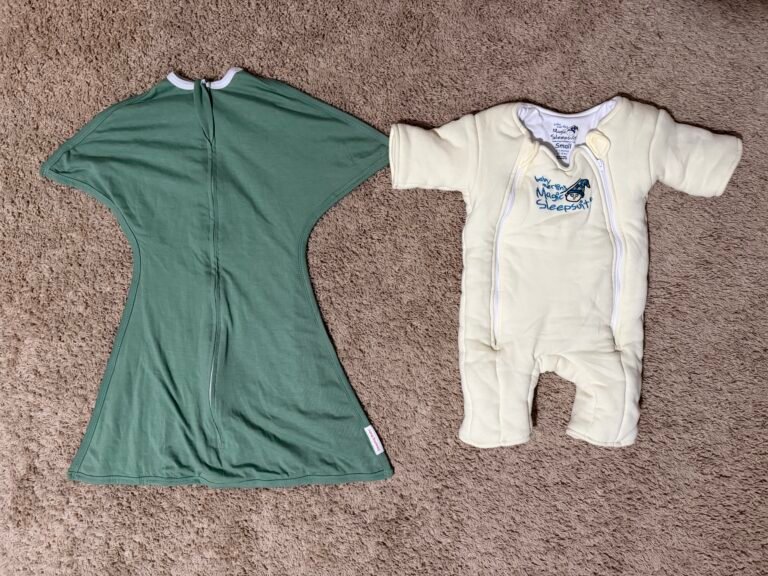
The startle reflex was very tough for our daughter, as she would wake herself up constantly. We scoured Reddit for advice on the best transition swaddles, and we ended up purchasing the Zipadee-Zip Swaddle (we coined it as the Flying Squirrel swaddle). We used this swaddled for maybe one or two sleep sessions, but it was not the best fit for our daughter.
I had a couple of friends recommend the Magic Merlin Sleepsuit (we coined it as the Marshmallow suit). This…this was the transition swaddle our daughter needed. It allows baby’s arms to be out, but still restricted enough to not be woken up by the startle reflex given the fluffy nature of the material. Eventually we started to use the Magic Merlin Sleep Suit in the SNOO bassinet as well—we laid our daughter on top of the SNOO swaddle (that was clipped in) and used the velcro straps to wrap around our daughter ’s mid section so that she was still secured into the SNOO. This approach worked wonders for us.
As with all babies when they start to roll, we had to move on from the Magic Merlin Sleep Suit (as it is not safe for babies who can roll over). With more Reddit research, we landed on the Baby Merlin’s Magic Dreamsack (same brand as the Magic Merlin Sleep Suit). These sleep sacks were a great transition for our daughter, as she was familiar with the material. At the time we started sleep training our daughter, she was fully using these sleep sacks for her daytime naps in the crib, and she started for nighttime sleep as well.
When summertime came around, we decided to switch sleep sacks to the HALO brand, as these were lighter weight (for the warmer weather). The HALO sleep sacks were recommended to us by a lot of people, and they have been great for our daughter. We’re currently in the process of deciding when to transition out of sleep sacks and just to a blanket!


SNOO Bassinet to Crib Transition
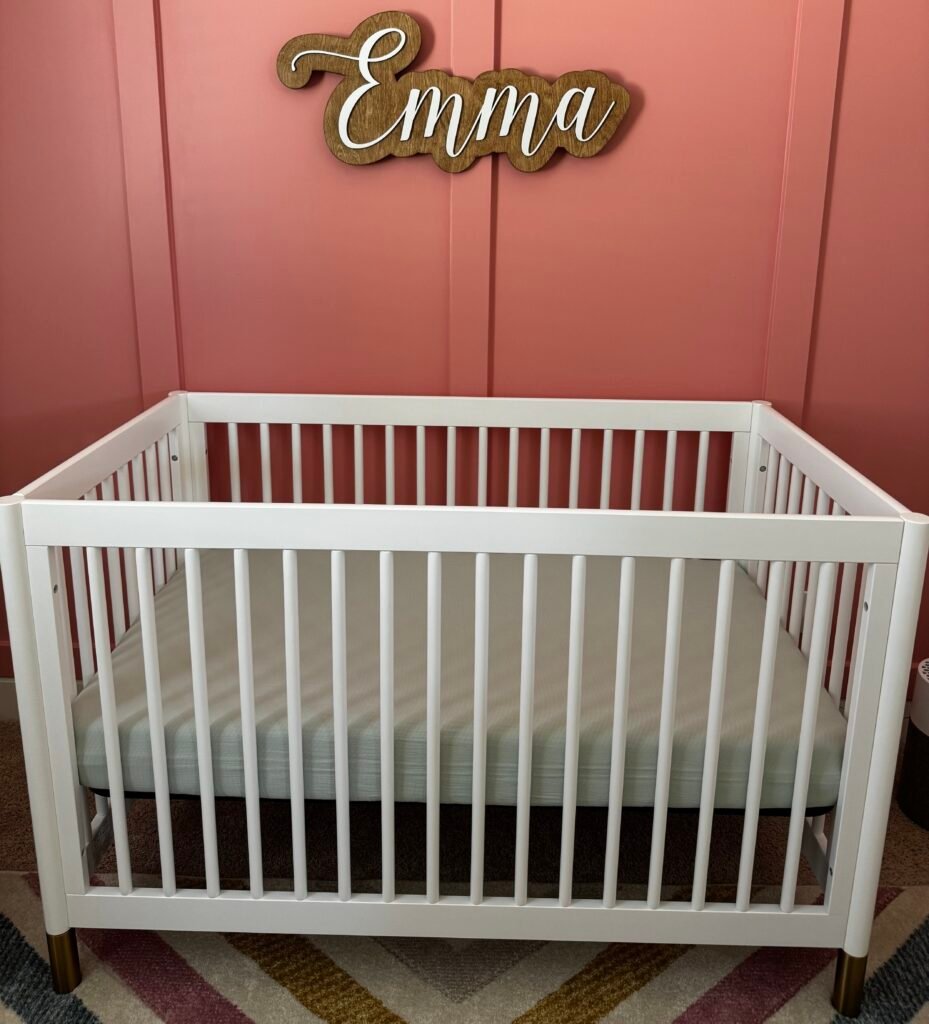
We introduced the crib to our daughter around 3 months old. She was primarily sleeping in the SNOO and her Pack n’ Play bassinet until then. As she started to get older (and taller) and her ability to roll over changed, we had to move her out of the Pack n’ Play bassinet. We wanted to get her introduced to the crib, as she would eventually move out of our bedroom and into her room (in her crib) full time around 5-6 months old.
We started with naps for the crib introduction. This worked well to give her time to get used to it for short periods before jumping into it overnight. For a while, the crib was working fine for nap time; however, around 3-4 months she started to struggle with her naps (in part due to her arms waking her up, as she was transitioning out of the full swaddle with arms down).
For my sanity, I started alternating crib naps with SNOO naps, so that I could guarantee some nap time sleep (with the SNOO). I know this was kind of a step backwards, going from crib to bassinet, but it was what worked for us at the time. Eventually, we got her back onto crib naps full time in mid-November. We then started sleep training in early December, so she had about a month of crib-only naps, where she could get used to sleeping in her crib (and room) regularly.
Daycare Transition
As mentioned in my Daycare blog post, we started our daughter in daycare at 6 months old. She started in the Infant classroom there, whereby she did not have a set schedule, and the teachers followed the schedule we had for her at home.
However, napping at home (in a quiet, dark room with a sound machine) vs napping at daycare (in a loud, lit room) was very different. As such, our daughter’s nap schedule definitely shifted when daycare started. Her teachers tried to follow our schedule as best as they could, but it didn’t always work out and some days our daughter would nap two 1+ hour naps. On other days, our daughter would nap for 15 minutes and skip her second nap.
Every day was different, and we adjusted her bedtime accordingly by following her cues. This was initially a struggle for me as I wanted to better control her sleep schedule at daycare, but realized that isn’t realistic nor feasible.
I had read that babies transition from 2 naps to 1 anywhere between 1 year old and 2 years old. Our daughter transitioned to the First Steps class (12 months – 24 months old kids) at daycare a few weeks before her 1st birthday. With this transition came a more scheduled day at daycare—she had scheduled snack times (AM and PM snacks), lunch, and nap (quiet) time.
My husband and I were initially taken aback by this new schedule as it seemed like a sudden shift for our daughter to completely adjust her whole day. We also couldn’t believe she was already old enough to move up classes.
However, daycare was very considerate and helpful with this transition, as they helped our daughter work on a 1 nap a day schedule while still in the Infant room in the weeks leading up to moving classes. It turned out that the transition to 1 nap a day helped our daughter sleep even better at daycare, as all of the other kids in her class were on the same schedule (so they all went to sleep at the same time, in the same dark room).
While she transitioned to a 1 nap a day schedule at daycare (5 days a week), we slowly worked on transitioning her from 2 naps to 1 at home (on the weekends). We didn’t want to force her into this new schedule at home just yet, as it all just varies on the day. Some days she takes 1 nap during the day, while on other days she takes 2 naps during the day.
Conclusion
Every baby has their own unique sleep journey, and eventually babies will learn how to sleep through the night. The sleep journey is one of the biggest adventures of parenthood and there are many ups and downs through it. Remember to laugh and have those middle of the night dance parties—it’s one of the best ways to survive the newborn phase.
While there are always sleep regressions, babies will get back into their sleep routine in no time. No matter which route you take, you and your family will figure out the best sleep for your baby. You’ve got this momma!